

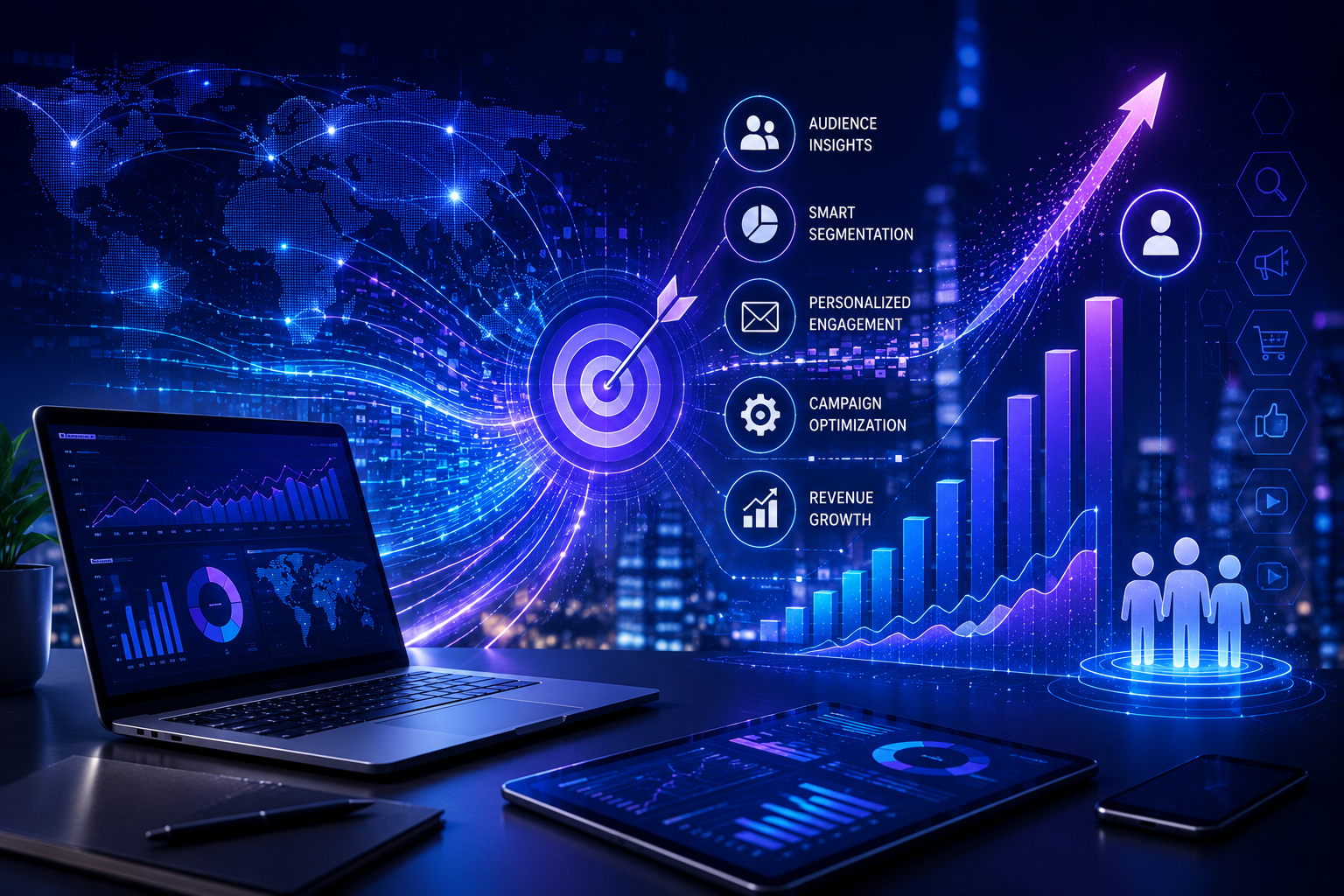
Data-Led Marketing Strategies for B2B Growth
Introduction
B2B marketing has evolved significantly over the past decade. Traditional marketing approaches that relied heavily on assumptions, broad targeting, and historical campaign performance are no longer sufficient in today’s highly competitive digital landscape.
Modern buyers interact with businesses across multiple channels, consume content throughout complex decision-making journeys, and expect personalized experiences at every stage of engagement. As a result, organizations need greater visibility into customer behavior, campaign effectiveness, and revenue impact.
This is where Data-Led Marketing has become a critical business capability.
Rather than making decisions based on intuition alone, Data-Led Marketing enables organizations to use customer insights, behavioral data, predictive analytics, and performance intelligence to improve marketing effectiveness and accelerate business growth.
At Sciens, Data-Led Marketing is viewed as a strategic framework that connects data, analytics, AI, and business objectives to create measurable outcomes across the entire customer lifecycle.
Why Traditional B2B Marketing Models Are Losing Effectiveness
The modern B2B buying process is increasingly complex. Decision-makers engage with multiple touchpoints before making purchasing decisions, making it difficult for organizations to understand what truly influences conversion outcomes.
Limited Visibility Creates Marketing Inefficiencies
Many organizations continue to struggle with fragmented customer data and disconnected marketing systems.
Common challenges include:
- Inconsistent reporting
- Limited campaign visibility
- Poor audience segmentation
- Inaccurate attribution models
- Inefficient budget allocation
Without Data-Led Marketing, businesses often invest resources into activities without clearly understanding their impact on pipeline growth and revenue generation.
The Shift Toward Intelligence-Driven Marketing
Today’s marketing leaders require more than campaign metrics. They need actionable intelligence that helps identify opportunities, predict outcomes, and improve decision-making.
Data-Led Marketing helps organizations move beyond reporting and toward strategic optimization by providing deeper visibility into customer behavior and business performance.
Using Customer Intelligence to Improve B2B Engagement
Understanding customers has become one of the most valuable competitive advantages in modern marketing.
Building Deeper Audience Understanding
Customer interactions generate valuable signals across websites, social channels, CRM systems, sales platforms, and digital campaigns.
Data-Led Marketing enables organizations to connect these insights and develop a comprehensive understanding of:
- Buyer behavior
- Content engagement
- Decision-making patterns
- Purchase intent
- Customer needs
This helps businesses create more relevant and personalized engagement strategies.
Enhancing Customer Journeys
B2B customers expect seamless experiences throughout the buying process.
By analyzing customer journey data, organizations can identify friction points, improve engagement pathways, and optimize conversion opportunities. This creates more effective marketing experiences while supporting long-term customer relationships.
How Predictive Analytics Strengthens Marketing Performance
One of the most powerful advantages of Data-Led Marketing is its ability to move beyond historical reporting and support future-focused decision-making.
Anticipating Customer Behavior
Predictive analytics helps organizations identify patterns that indicate future actions.
This enables marketing teams to:
- Prioritize high-value opportunities
- Predict lead conversion likelihood
- Forecast customer engagement
- Improve campaign planning
- Optimize resource allocation
Rather than reacting to outcomes, businesses can proactively influence them.
Improving Revenue Forecasting
Marketing performance is increasingly measured by its contribution to revenue growth.
Data-Led Marketing helps organizations connect marketing activities to business outcomes through better forecasting, performance visibility, and revenue intelligence.
This strengthens alignment between marketing, sales, and executive leadership teams.
Measuring Marketing ROI More Effectively
Demonstrating marketing value remains a priority for business leaders.
Moving Beyond Vanity Metrics
Metrics such as impressions, clicks, and engagement rates provide useful information, but they do not always reveal business impact.
Data-Led Marketing focuses on outcomes that directly influence organizational performance, including:
- Pipeline contribution
- Revenue generation
- Customer acquisition
- Retention performance
- Lifetime customer value
This allows organizations to evaluate marketing investments more effectively.
Strengthening Attribution Models
One of the biggest challenges in B2B marketing is understanding which activities contribute most to conversions.
Advanced attribution frameworks help organizations identify high-performing channels, campaigns, and touchpoints, enabling smarter investment decisions and improved marketing efficiency.
Why Data-Led Marketing Is Becoming a Competitive Advantage
Organizations that successfully implement Data-Led Marketing gain significant advantages in today’s digital marketplace.
These advantages include:
- Better customer intelligence
- Improved campaign performance
- Stronger marketing ROI
- More accurate forecasting
- Enhanced decision-making
- Greater revenue visibility
At Sciens, Data-Led Marketing solutions help organizations connect analytics, AI, customer intelligence, and business strategy into a unified framework that supports sustainable growth.
As competition continues increasing across industries, organizations that leverage data effectively will be better positioned to attract customers, optimize marketing investments, and accelerate business performance.
Conclusion
Marketing is no longer just about creating awareness or generating leads. It has become a strategic business function that directly influences growth, customer relationships, and revenue outcomes.
Data-Led Marketing enables organizations to make smarter decisions, improve customer experiences, optimize campaign performance, and strengthen business results through actionable intelligence.
Businesses that embrace Data-Led Marketing are not simply improving reporting capabilities. They are building intelligence-driven marketing ecosystems capable of delivering measurable and scalable growth.
In 2026 and beyond, organizations that successfully combine data, analytics, AI, and customer intelligence will be the ones that lead their markets and create sustainable competitive advantage.
FAQs
1. What is Data-Led Marketing?
Data-Led Marketing is a strategy that uses customer insights, analytics, and performance data to improve marketing decisions and business outcomes.
2. How does Data-Led Marketing improve B2B growth?
It helps organizations improve targeting, optimize customer journeys, enhance campaign performance, and drive revenue growth through actionable insights.
3. Why is customer intelligence important in B2B marketing?
Customer intelligence provides deeper visibility into buyer behavior, engagement patterns, and decision-making processes, enabling more effective marketing strategies.
4. How does predictive analytics support marketing performance?
Predictive analytics helps organizations forecast customer behavior, prioritize opportunities, and optimize marketing investments.
5. How does Sciens help businesses implement Data-Led Marketing?
Sciens helps organizations leverage analytics, AI, customer intelligence, and revenue insights to build scalable marketing strategies that support measurable business growth.
Ideas that inform and inspire.
Book a free 30-minute strategy consultation with our experts.
